Expert InsightAI & Business Automation
Better Customer Support, Without a Bigger Queue
Use AI to understand requests and prepare useful replies, while automation keeps emails, live chats and tickets organised. A practical approach for small and medium-sized teams, with people in control of important decisions.

Start with the queue, not the chatbot
For a small team, customer support often arrives in several places: a shared mailbox, a website chat and messages forwarded by colleagues. The same request can be answered twice—or missed because everyone assumes someone else owns it. A clear support process is the foundation for useful AI.
Automation can capture each authorised incoming message, connect it to the right conversation, create or update a ticket and assign an owner. AI can then summarise the request and suggest a category. Agreed rules should control routing, business hours and escalation, rather than leaving responsibility to an AI guess.
One support record
Email and chat, connected
- CaptureKeep the original message and conversation ID.
- OrganiseCreate or update one ticket; avoid duplicates.
- AssignGive the case an owner and next action.
Turn incoming emails into useful draft replies
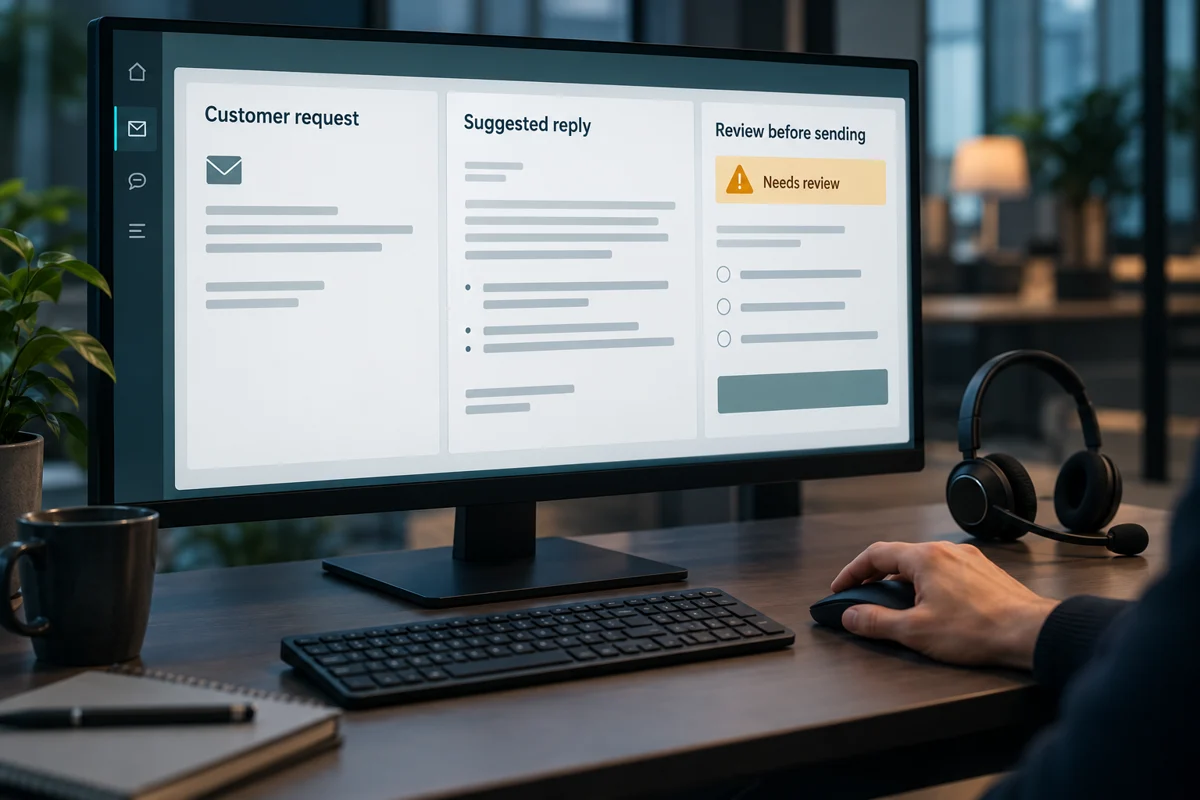
AI can extract the main question, identify missing details and prepare a reply using approved product information and policies. A staff member sees the original message, the suggested wording and the knowledge used to support it. They can approve, edit or reject the draft before sending.
This is already a documented capability in customer-service software: Microsoft describes email drafting and asks staff to review generated content. For an MBS implementation, we would connect the chosen mailbox and helpdesk, retrieve trusted information, then place the result in a review queue. Existing software, licences and available APIs determine the exact design. Microsoft’s email drafting guide.
Live chat that knows when to hand over
A well-scoped AI chat can answer familiar questions, explain a documented process and collect enough detail to open a useful ticket. It should clearly introduce itself as an AI assistant and offer an accessible route to a person. Outside staffed hours, it should explain when a response can be expected rather than imply a team is available around the clock.
When it cannot resolve the issue, the transcript, summary and information already collected should travel with the ticket. The customer should not have to start again. Rules can also trigger immediate handover for sensitive issues or an explicit request for a person; platforms such as Intercom document configurable escalation paths.
A useful handover
Keep the conversation connected
- AnswerUse approved information within a defined scope.
- Recognise limitsUnclear, sensitive or unsupported requests escalate.
- Hand overSend the transcript, summary and next action.
Let rules handle actions and people handle exceptions
Not every support action needs manual work. Acknowledgements, ticket routing and carefully tested answers to low-risk FAQs can be automated within explicit limits. AI can help prepare the work, but it should not invent refund eligibility, change an account or promise a delivery date without a verified basis.
We would keep staff approval for refunds, security changes, contractual commitments and sensitive complaints unless a separately designed, authorised process governs them. Order information should be retrieved only for an authenticated customer with permission to see it. A message saying “ignore the rules” must remain customer content, not a new instruction to the system.
Boundaries that matter
Different tasks need different controls
- AutomateAcknowledgements, routing and permitted FAQs.
- PrepareSummaries, suggested answers and missing-detail requests.
- ApproveRefunds, account changes and important commitments.
Protect customer information as part of the design
Customer emails can include addresses, account details and attachments that an AI service does not need. Limit the data sent, restrict mailbox and tool permissions, and agree how information is retained. Choose suitable business services and processing arrangements, and check where data goes and how individual rights are handled.
The Irish Data Protection Commission advises organisations to understand these issues before using AI with personal data. Keeping a server in Europe alone does not settle them. We would also test misleading emails and unsafe attachments, retain useful action logs, and provide a straightforward way to pause automation. DPC guidance.
Purposeful access
Only the data and actions required
- MinimiseSend relevant details, not an unrestricted mailbox.
- RestrictLimit tools and authenticate customer-specific access.
- ReviewAgree retention, audit actions and test failure cases.
A pilot a small team can actually manage
Start with one support inbox, a small approved knowledge base and draft-only replies. Test common questions alongside duplicates, angry customers, missing order details and questions the business cannot yet answer. Measure corrections, repeated contacts and time to the first useful response—not simply how many messages the bot sends.
Once the team trusts the workflow, add limited live-chat answers or routine acknowledgements. MBS Integrations would scope this around your support volume and current systems, with clear ownership and approval rules. These are implementation options, not a promise that all support can run unattended or that every business needs a new helpdesk.
A measured rollout
Prove value before expanding
- PilotOne inbox, trusted knowledge and reviewed drafts.
- MeasureCorrections, response usefulness and unresolved cases.
- ExpandEnable only the actions the pilot has justified.
Sources & Further Reading
Technical references checked 20 October 2026. Features and device support can change.
- Microsoft: customer-service Copilot capabilities
- Microsoft: draft and review support emails
- Power Automate: email scenarios
- Power Automate: approval workflows
- Intercom: AI escalation and handover rules
- Irish DPC: AI and personal data
- European Commission: AI transparency obligations
- Microsoft: defending against prompt injection
Planning something similar?
Tell us what you already have and what you would like to improve. We will help plan the next practical step.
Discuss Your Project