Expert InsightAI & Business Automation
Missing Calls While You Work?
An AI receptionist can answer routine calls, capture useful details and help with bookings when your team is busy. Here is what it should do, where people still matter and how a small business can start sensibly.

The phone rings while the work carries on
When you are fitting a kitchen, serving a customer or meeting a client, answering every call is not always realistic. Voicemail can help, but a caller may need a simple answer or an appointment before you are free to call back. That is a practical place to consider an AI receptionist.
In research published in October 2026, 67% of 1,500 surveyed UK SME decision-makers said they miss at least one call on an average day that they believe costs them business. This was vendor-commissioned, self-reported UK research—not a measurement of Irish losses—but it highlights a familiar small-team problem.
The first question is how many useful calls your own business misses. Review that pattern before buying a system. Low call volume or mostly complex conversations may make a simple callback process the better investment.
Start with your own call pattern
The phone rings while the work carries on
- When?Busy periods, time on site and after-hours calls.
- What?Common questions, booking requests and callbacks.
- How often?Useful missed calls, not just total call volume.
A conversation, not another phone menu
Many callers associate automated answering with rigid IVR menus: “press one”, repeat your details, then wait in another queue. A well-designed conversational AI receptionist works differently. Callers can explain what they need in their own words, ask a follow-up question and correct a detail without navigating a fixed menu tree.
Connected to the right workflows, it can answer routine questions immediately, capture job details once and pass the context to the team or booking system. That can shorten routine call handling, reduce repeated questions and get enquiries to the right next step sooner. The benefit depends on accurate information, responsive speech and a reliable handover—not simply adding an AI voice.
A more natural way to get help
A conversation, not another phone menu
Give it a receptionist’s job
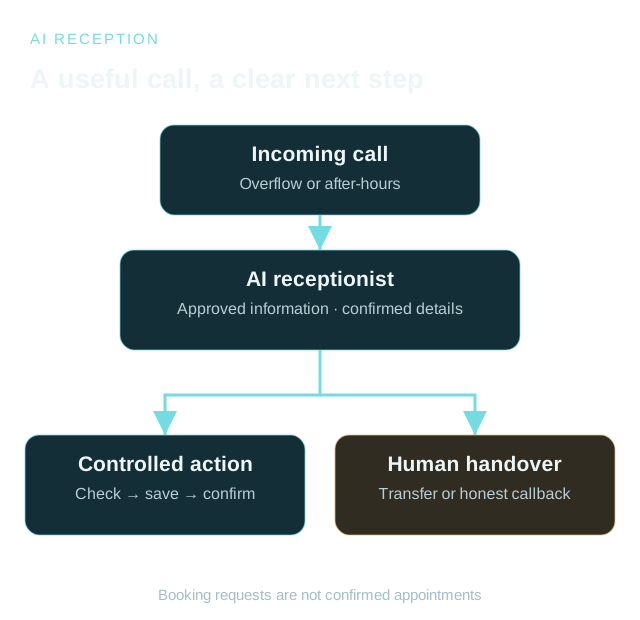
A bounded system can introduce itself as an AI assistant, answer approved questions about opening hours or services, and collect a name, callback number and short description of the job. It can prepare a useful summary for the team instead of leaving someone to replay a long message.
Use current business information and clear limits. The assistant should not invent a price, promise an urgent visit or say a job is accepted when it has only collected an enquiry. It should confirm important details, especially names, phone numbers and addresses.
Overflow or after-hours routing is often a sensible starting point. Keeping the existing number may be possible through your provider’s routing arrangements; Irish number support, forwarding charges and caller-ID behaviour need checking before choosing a platform.
Clear boundaries
Give it a receptionist’s job
- AnswerApproved service information and common questions.
- CaptureOnly the details needed for the next step.
- EscalateUncertainty, exceptions and requests for a person.
A booking needs more than a friendly voice
To confirm appointments, the assistant needs a working connection to the actual calendar or booking system. That integration should enforce service areas, appointment duration, staff availability, travel time and buffers—not merely look for an empty calendar square.
The workflow should check availability again when saving, prevent duplicate bookings and return a definite result. If the calendar cannot be reached or the booking fails, the caller should hear that a request has been taken for follow-up, rather than a false confirmation.
A practical implementation links the phone platform to controlled booking actions and your CRM, using automation where appropriate. The language model handles the conversation; explicit rules decide which actions are allowed and what counts as success.
From conversation to confirmed action
A booking needs more than a friendly voice
Make it easy to reach a person
Some callers will want a person immediately. Others may describe an unusual problem, become frustrated or share information the assistant should not handle. Define these handover points before launch and make asking for a person straightforward.
A transfer needs a reachable destination, opening-hour rules and a fallback if nobody answers. Pass along a short summary where the systems support it so the customer does not have to start again. If a live transfer is unavailable, offer an honest callback arrangement.
A basic receptionist should not take payment-card details or give medical or legal advice. Keep its responsibilities narrow, and ensure the business can pause the AI routing quickly if it is not serving callers well.
A usable human handover
Make it easy to reach a person
- Caller choice“I would like to speak to someone.”
- ContextShare the reason for calling where supported.
- FallbackOffer a callback if the team cannot answer.
Keep customer information purposeful
Voice calls can contain more personal information than expected. Decide what must be collected, who can access it and how long it is needed. Recording and transcription are separate configuration decisions; neither should be enabled simply because the platform offers it.
Give callers clear information about the AI and any recording or transcription. Review the provider’s data handling, relevant agreements, retention settings and access controls. Irish Data Protection Commission guidance emphasises transparency, minimisation, security and retaining personal data only as long as necessary.
Using an established provider does not automatically make a particular deployment compliant. The business still needs an appropriate basis for its processing and a setup suited to the information it handles.
Collect what the next step needs
Keep customer information purposeful
- PurposeWhat information is required to help this caller?
- AccessWhich team members and providers need it?
- RetentionWhen should recordings, transcripts and records expire?
Pilot it on real business situations
Test local accents, background noise, interruptions, unclear addresses and changes of mind. Also test calendar failures and transfers when nobody answers. A polished demo is useful, but everyday exceptions reveal whether the system is ready.
Measure useful enquiries captured, booking accuracy, successful handovers and caller feedback. Include telephony, AI usage, subscriptions, integration and ongoing review in the cost. Availability also depends on the phone, cloud and connected systems; no service should be presented as infallible.
MBS Integrations can help define the call flow, connect suitable systems and run a limited pilot before broader rollout. Explore AI & Business Automation or discuss the calls your team struggles to cover.
Prove the service before expanding
Pilot it on real business situations
Sources & Further Reading
References checked 4 November 2026. Features, tariffs and service availability can change.
Planning something similar?
Tell us what you already have and what you would like to improve. We will help plan the next practical step.
Discuss Your Project