
Expert InsightSmart Home
A Smart Home Should Do More Than Replace One Remote With Ten Apps
More connected devices should mean less everyday effort. Here is how integration turns individual app controls into a home that responds to context.

Connected is a starting point. Automated is a step further.
A wall switch is direct control. A connected light adds a network connection; its app adds remote control. Neither, on its own, decides whether the room needs light.
When lighting, heating and blinds live in separate apps, you become the integration layer: noticing what changed, choosing the right app and repeating the same actions. Adding devices can add work.
An integrated home shares useful information between compatible systems. Context-aware automation uses that information to handle routines while keeping manual control available.
Start with a useful decision.
Home Assistant describes automations in terms of triggers, conditions and actions. A trigger starts the check; conditions decide whether the actions should run. Our design work is deciding which signals and safeguards make that sequence useful in your home.
For example, motion in a hallway may call for gentle lighting at night, brighter lighting during a dark afternoon, or no change when daylight is sufficient. A manual override should still make sense.
Presence is a signal, not certainty. A stationary person may not trigger a motion sensor. Occupancy decisions may need more than one input, a delay before switching off and a predictable fallback if a sensor stops reporting.
Open app → press button → device reacts
Presence / time / daylight → logic → house reacts
Central integration connects the context.
A platform can bring supported lighting, heating, blinds, energy information and sensors into one system. That makes a house mode meaningful across more than one product family.
Arriving home
Confirmed arrival can select a home mode, enable appropriate lighting and adjust heating if needed. Changes to alarms or locks need separately agreed, reliable conditions; phone presence alone should not unlock a property.
Night mode
A bedside action or agreed condition can switch off selected lights, reduce heating, check door states and close supported blinds. A door check reports its sensor state; it does not prove the door is locked.
Leaving home
Once nobody remains, unnecessary devices can turn off, heating can change mode and compatible security functions can follow an agreed arming process. Exceptions should draw attention only when useful.
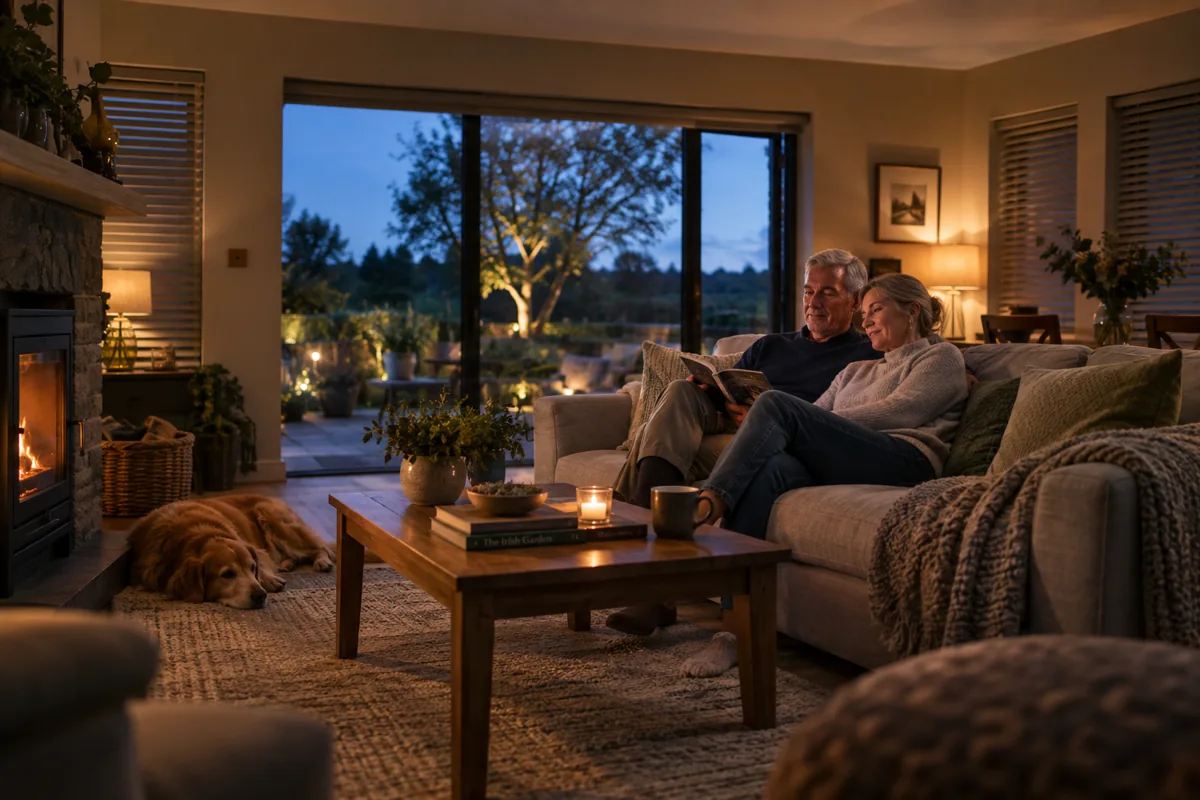
A useful overview. A clear way to intervene.
The dashboard is a place to see what matters and intervene when needed. It should not become the only way to operate a room. Familiar switches and understandable overrides help everyone use the home.
Energy information can inform optional loads, schedules or heating priorities where integrations expose the relevant measurements and controls. An automation should handle missing or stale data explicitly, rather than assume a reading is current.
Start with one routine, observe how it behaves and refine it. Keep an inventory of integrations, document overrides and test what happens if the internet or central platform is unavailable.
Choose the platform around your household.
Home Assistant, Homey and Hubitat are examples of platforms that can bring devices and automation together. Home Assistant offers an extensive integration ecosystem; Homey uses Flows; Hubitat includes Rule Machine. None is universally the right answer.
Assess your existing devices, the complexity you want, local-control requirements, integration support, maintainability and personal preference. Local operation depends on the specific devices and integrations as well as the platform; a local hub does not make a cloud-only device independent of the internet.
Keep what works. Integrate compatible systems. Replace only what genuinely needs replacing. The goal is to reduce interaction, not create more of it.
Explore our Smart Home Integration approach and solutions for your home.
Sources & further reading
Technical references checked 21 September 2026. Platform features and device support can change.
Planning something similar?
Every home or business starts with different equipment, constraints and goals. We can assess what you already have and design an approach around what actually needs to change.
Discuss Your Project