
Expert InsightSmart Home
Can Your Smart Home Lower Your Electricity Bill?
A cheaper tariff is only part of the picture. Connecting your energy use, EV charging, solar and battery controls can help you use electricity at better times—starting with the equipment you already own.
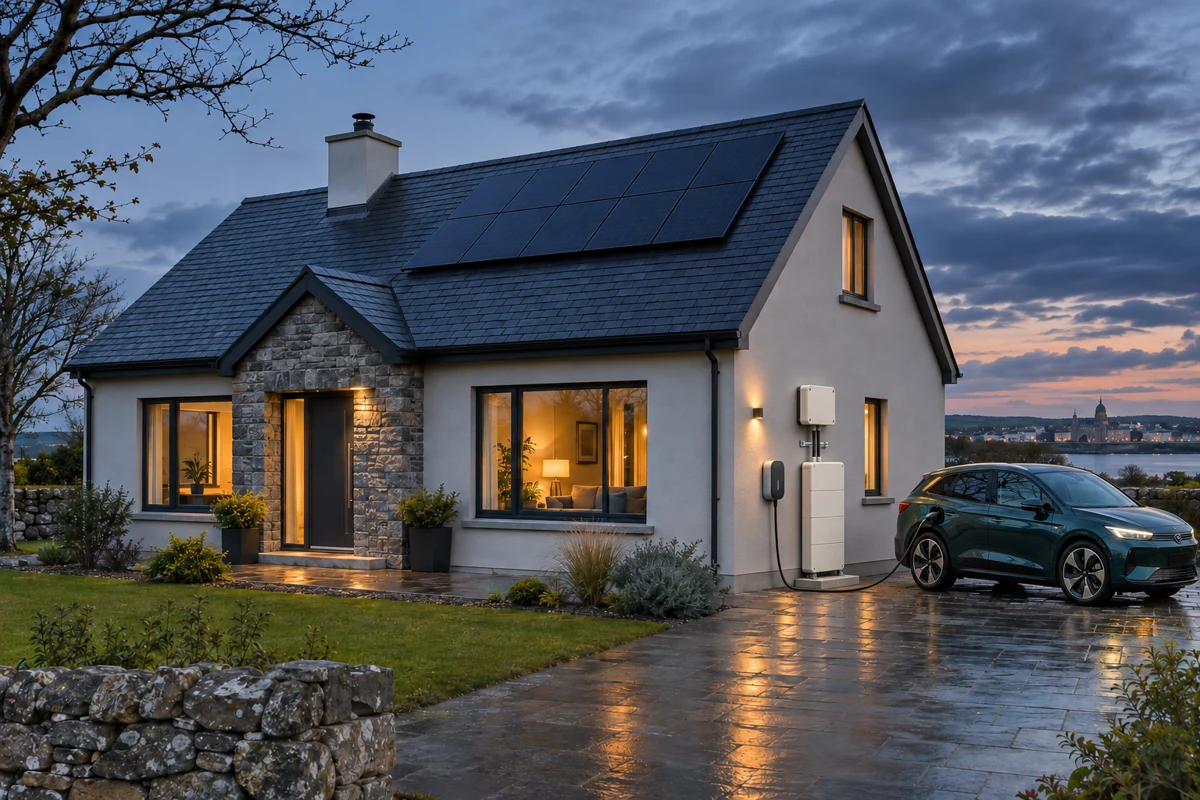
Start with what your home actually uses
A smart home can help reduce unnecessary electricity use and move flexible demand to better times. It cannot promise a smaller bill simply because another device has been installed. The useful starting point is understanding how much electricity your home uses, when it uses it and which activities can reasonably move.
Start with your ESB Networks online account, where smart-meter customers can review usage patterns and download their half-hourly HDF consumption file. Tools such as Kilowatt.ie and EnergyPal.ie can use that history to compare plans against when you actually use electricity. Check the period covered and the supplier’s current terms before switching.
Compatible energy monitoring can add detail about individual circuits or devices. Home Assistant’s energy tools can bring grid imports, exports and generation into one view. Monitoring shows what happened; changing equipment behaviour requires suitable controls and a separate automation.
Start with one worthwhile change, such as scheduling a compatible EV charger around your tariff and departure time. You do not need solar panels or a battery to begin.
Measure before buying
Start with what your home actually uses
- ObserveReview bills and consumption by time of day.
- ChooseFind one flexible load with a useful saving opportunity.
- CompareCheck results against the original pattern.
Cheap hours and dynamic prices are different
A time-of-use tariff has defined price bands, such as day, night and peak periods. A dynamic tariff changes with the wholesale market. The CRU explains that Irish dynamic tariffs use 48 half-hour prices each day, published in advance. Eligible customers have been able to access these tariffs since June 2026; supplier and smart-meter requirements still apply.
Automation can use a supported price feed to schedule flexible work, but a dynamic tariff is not automatically the best option. A predictable overnight EV rate may suit one household better, while another can move enough consumption to benefit from changing prices.
Compare the annual cost using your own usage, including standing charges, all import rates and any export payments. An attractive overnight headline can be outweighed by expensive daytime use. If no dependable price integration exists, a simple supported schedule can be the more practical choice.
Choose the tariff around the household
Cheap hours and dynamic prices are different
Let the useful equipment work together
Solar generation, household demand, a battery and an EV can otherwise make decisions in isolation. A charger might draw heavily while a battery is also charging, or the household could export energy it needs shortly afterwards. Coordinated controls can weigh those competing needs.
A sensible plan might preserve a battery reserve, prioritise enough EV charge for tomorrow’s journey and use available solar for a flexible hot-water cycle. Whether surplus solar should be used, stored or exported depends on your actual rates, storage losses and likely later demand—not a universal rule.
SEAI has documented a residential demonstration connecting solar, storage, hot water and EV charging with price-based control. It illustrates what coordination can achieve; the results of that particular project are not a forecast for every home.
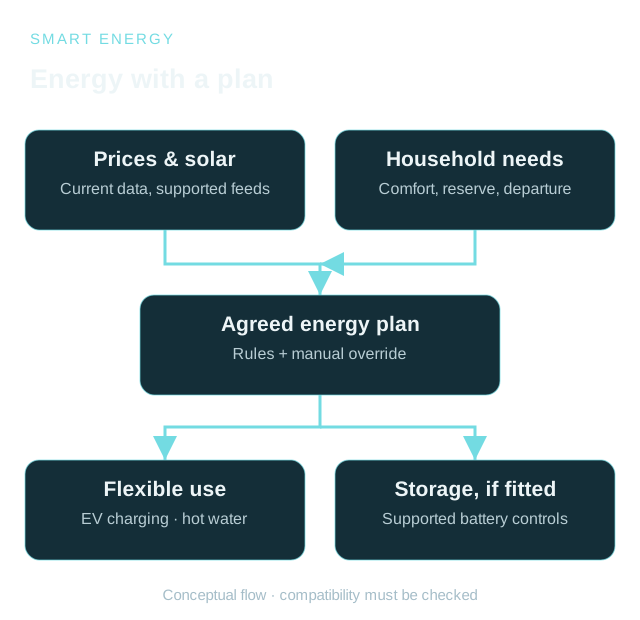
One plan for competing needs
Let the useful equipment work together
- Household needsComfort, hot water and departure time come first.
- Available energyConsider solar output, grid price and battery reserve.
- Supported controlsCoordinate compatible equipment within its limits.
Build in stages, with comfort protected
An affordable first stage can be better visibility and schedules using existing manufacturer controls. A second stage might connect supported devices through Home Assistant or Homey so that tariff, occupancy or available solar can influence a routine. Larger hardware purchases should follow an assessment of their own costs and benefits.
Compatibility must be checked at model and integration level. Reading a device’s energy use does not necessarily mean it can be controlled. Cloud access, subscriptions and supplier changes can also affect what remains available.
Use manufacturer-supported controls for chargers, heating and battery systems. Ordinary smart plugs are not a substitute for correctly rated control of high-load equipment. Electrical installation and changes to fixed wiring need the appropriate qualified installer.
A proportionate investment
Build in stages, with comfort protected
A good automation needs a fallback
A cheaper hour is not helpful if the car is unready when you leave or the house becomes uncomfortable. Define minimum charge, comfort settings and the times when each task must be complete. Include an obvious manual override so the household can change plans without editing an automation.
Agree what should happen if a tariff feed, sensor or internet connection fails. A safe existing schedule or the equipment’s own controls should take over where appropriate. Avoid having two systems repeatedly override each other.
Check results over a representative period and account for changing weather, mileage and occupancy. Compare both electricity use and cost: shifting demand can lower cost without reducing consumption, while a genuinely efficient routine can reduce both.
People stay in control
A good automation needs a fallback
- Minimum needsSet charge, comfort and completion requirements.
- Manual overrideAllow a straightforward change of plan.
- Failure behaviourKeep an agreed fallback when data is unavailable.
Start with one clear energy goal
For one household the goal is a charged car at a lower cost. For another it is making better use of solar without watching several apps. The most useful system is the one that fits your equipment, routine and budget, and can explain what it is doing.
MBS Integrations can assess the controls you already have, confirm suitable integrations and design a staged approach. We would agree the priorities, fallback behaviour and how to measure the result before expanding the system.
Explore our Smart Home service or tell us about your existing equipment to discuss a practical starting point.
A clear starting brief
Start with one clear energy goal
- Your equipmentTariff, meter, charger, heating, solar and storage.
- Your prioritiesSavings, convenience, comfort and budget.
- Your first improvementOne bounded routine with a measurable result.
Sources & Further Reading
References checked 4 November 2026. Features, tariffs and service availability can change.
- CRU: Dynamic Price Tariffs for Electricity
- Electric Ireland: Dynamic price plans and eligibility
- Home Assistant: Integrating your electricity grid
- SEAI: Testing renewable energy flexibility based on price
- ESB Networks: View and download your smart-meter usage
- Kilowatt.ie: Compare plans using actual usage
- EnergyPal.ie: Smart-meter tariff comparison
Planning something similar?
Tell us what you already have and what you would like to improve. We will help plan the next practical step.
Discuss Your Project