
Expert InsightSmart Home
A Small Leak Should Not Become a Big Surprise
Water sensors, clear alerts and a suitable shut-off valve can give you more time to act. Here is how to choose useful protection around your home without confusing leak detection with guaranteed prevention.
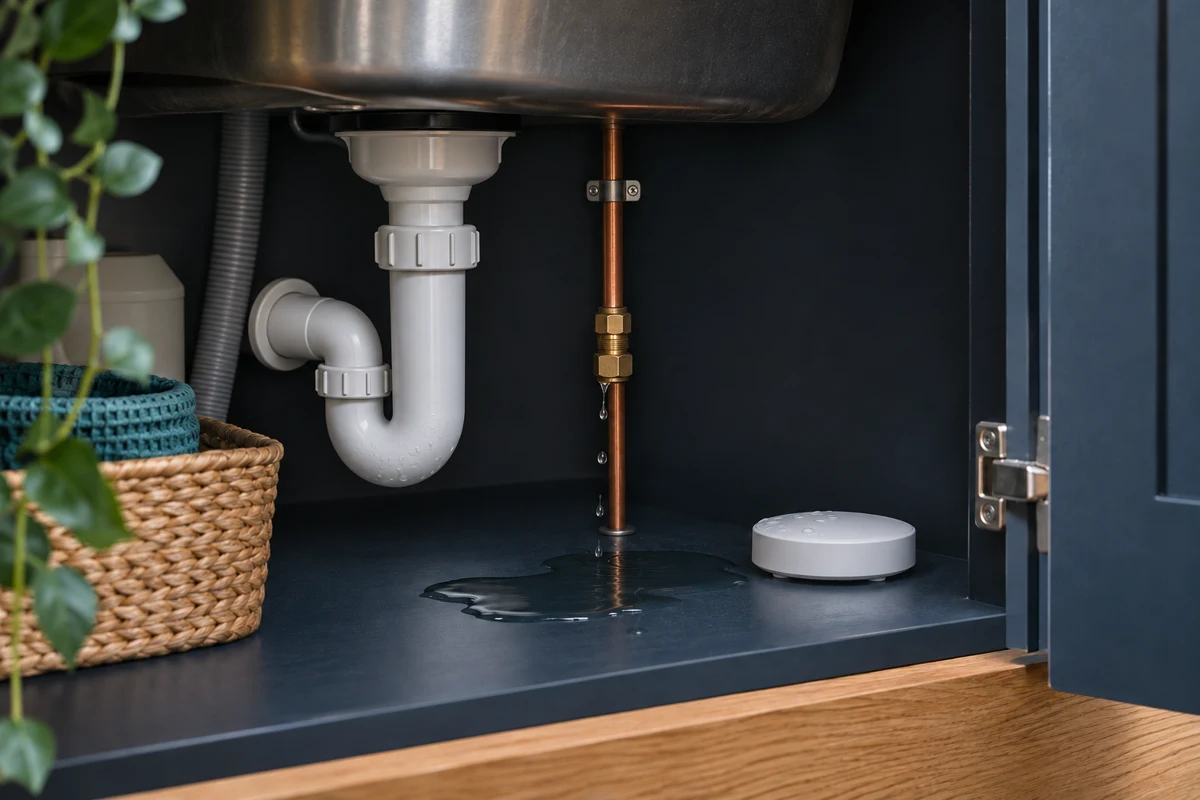
Start where water could cause the most trouble
A slow drip behind a washing machine can remain unnoticed until the floor or cabinetry shows damage. Smart leak detection aims to shorten that delay. The useful question is not how many sensors a home can support, but where an early warning would make the biggest difference and who could respond to it.
Walk through the property and identify accessible points near washing machines, dishwashers, sinks, water cylinders and other vulnerable connections. Consider the likely path of escaping water. A sensor on a convenient shelf may stay dry while water runs underneath it; a sensor buried behind stored belongings may become difficult to inspect.
Start with a few well-chosen positions and a clear response plan. For a holiday home or a property left empty during the working day, notification arrangements matter as much as the device itself. No sensor can report water that never reaches its detection area.
Place for the likely leak
Start where water could cause the most trouble
- Find the riskAppliances, joints and vulnerable finishes.
- Follow the waterPut the detector where water would collect.
- Keep accessAllow inspection, cleaning and battery replacement.
A puddle sensor and a flow monitor do different jobs
A point sensor detects water at its own location. Aqara’s Water Leak Sensor T1, for example, uses two contacts and reports through a compatible hub when water connects them. This makes it useful near a likely leak, but it is not a whole-house measurement of water consumption.
A flow-monitoring system watches water passing through the pipe where it is installed. Depending on the product, it may identify unusual duration, volume or pressure changes. GROHE Sense Guard combines monitoring with a shut-off function. Such equipment needs suitable plumbing and correct settings for the property.
These approaches can complement each other. A local sensor identifies a wet area; flow information can reveal a different pattern. Neither automatically covers roof leaks, every concealed pipe, drainage problems or every branch of a plumbing system. Define the intended coverage before choosing equipment.
Different evidence, different coverage
A puddle sensor and a flow monitor do different jobs
Make the warning useful when it arrives
An alert saying “Kitchen sink leak detected” is more useful than an unexplained device number. Agree who receives the message, whether another household member should be notified, and what happens if nobody acknowledges it. A phone in silent mode should not be the entire response plan.
An audible warning from a suitable alarm or hub can help when someone is at home. Check this capability explicitly: a small wireless sensor does not necessarily contain a siren. Where compatible, an integration platform can combine the alert with a light indication or repeated notifications.
Keep urgent messages specific and proportionate. Include the affected location and an instruction to check it safely. Do not silently clear an incident merely because the contacts dry out. The original cause may remain, and an alert being acknowledged is different from the plumbing being repaired.
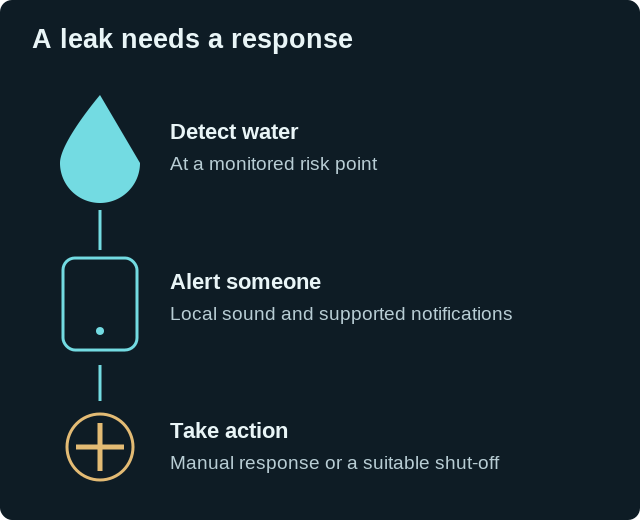
Automatic shut-off needs a plumbing plan
A suitable motorised valve can reduce the amount of water supplied after a detected leak. Some actuators fit over an existing compatible valve; others require an inline installation. Aqara’s Valve Controller T1 is a retrofit example with supported handle sizes and manual operation, but it will not fit every stopcock or installation.
Have a competent plumber confirm the isolation point, valve condition, access and effect on the connected system. Closing an incoming mains valve does not instantly remove water already stored in tanks or pipes. A separate supply or heating circuit may require a different assessment.
Agree which detections may close the valve and how people can intervene manually. Avoid automatically reopening it just because a sensor reports dry. Reopening should follow a check of the incident. A shut-off system can limit some damage; it cannot promise that a leak will never happen.
Detection is only part of protection
Automatic shut-off needs a plumbing plan
Test the failures as well as the alarm
Use the manufacturer’s recommended test method and verify the complete chain: detection, audible warning, phone notification and any approved valve action. Test from the final installed position. Metal enclosures, distance and depleted batteries can affect wireless communication, even when initial pairing worked on a table.
Ask what remains operational if broadband, the hub or mains power fails. Products differ: the GROHE guide describes different behaviour for internet loss and power loss. Do not assume a local sensor automatically creates a fully local shut-off system, or that every powered valve fails in the same position.
Include battery checks, offline-device warnings and periodic functional tests in the handover. Keep the ordinary stop valve identifiable and accessible. A system that has not reported a leak for months may be working perfectly, but that silence alone is not proof that its alarm path still works.
Prove the whole response
Test the failures as well as the alarm
- DetectUse a safe manufacturer-approved test.
- RespondConfirm alerts and intended valve behaviour.
- MaintainReview batteries, connectivity and access.
Build protection around your home
A sensible first stage is a handful of sensors at high-risk locations, with alerts the household understands. Add automatic isolation only after the plumbing and response behaviour have been assessed. This keeps the initial scope practical and avoids paying for features that do not address your property’s risks.
MBS Integrations can assess compatible devices, connectivity and alert routines, coordinating with the appropriate plumbing professional where valve work is needed. We would document what is covered, what is not, and how to test and override the system.
Explore our Smart Home service or tell us about the areas you want to protect. A useful brief starts with your appliances, plumbing access, time away from home and the people who should receive an alert.
A clear, staged brief
Build protection around your home
- Start smallCover the most consequential locations.
- Add controlAssess suitable isolation separately.
- Hand over clearlyKnow the limits, tests and manual response.
Sources & Further Reading
References checked 10 November 2026. Features and service availability can change.
Planning something similar?
Tell us what you already have and what you would like to improve. We will help plan the next practical step.
Discuss Your Project