Expert InsightAI & Business Automation
Reorder Before You Run Out—Without Buying on Autopilot
Connect stock, sales and supplier information to prepare better purchasing decisions. Clear rules handle the quantities; AI can help interpret exceptions, while your team approves the spend.

Start with stock you can actually trust
A business can have products on a shelf and still be unable to fulfil its next order. Some units are already promised, some are damaged and others belong at another location. Reordering from a single total can therefore create shortages or unnecessary purchases before AI enters the picture.
Agree which system owns the stock record and how sales, deliveries, returns and adjustments reach it. Use consistent product codes and units of measure. A supplier’s box of ten must not become ten boxes because one application records packs and another records individual items.
Shopify’s inventory documentation distinguishes on-hand, available, committed, unavailable and incoming quantities. Other systems use different labels, so map the meaning rather than assuming matching names. Regular physical checks remain important: software cannot reliably purchase against stock that was never counted or recorded correctly.
One trustworthy stock picture
Start with stock you can actually trust
- IdentifyConsistent product codes and units.
- SeparateAvailable, committed and incoming stock.
- ReconcileCheck system quantities against physical stock.
Use simple replenishment rules first
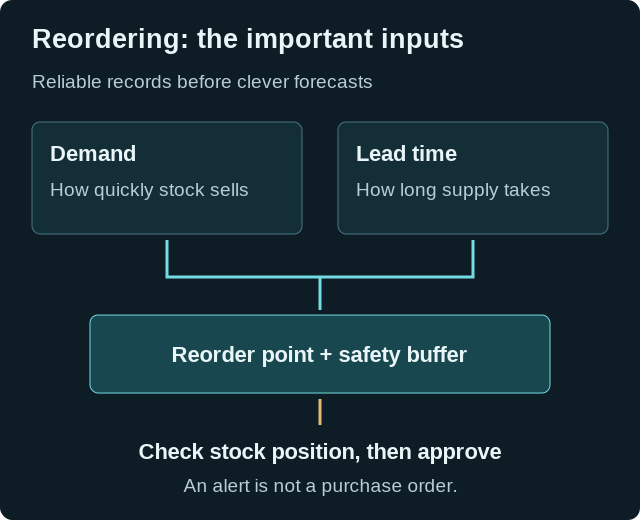
For steady-selling products, a clear reorder rule is often more useful than a complicated prediction. Estimate demand while a replacement order is being approved, supplied and received, then choose an appropriate safety buffer. Include your own purchasing delay as well as the supplier’s quoted delivery time.
The trigger tells you when to review a purchase; a target level helps determine how much to propose. Supplier minimums, pack sizes, storage limits, cash available and expiry dates can change the final quantity. A slow-moving item deserves a different policy from an essential consumable.
Odoo documents minimum/maximum replenishment rules and lead-time planning, including requests for quotation for purchased products. That is a useful example of structured replenishment, not a requirement to replace your existing system. First check which dependable stock and purchasing functions you already have.
Rules that people can explain
Use simple replenishment rules first
A worked example with the quantities visible
Consider a simplified example using individual units and working days. Average demand is four units per working day. Total approval-and-delivery lead time is five working days, and the agreed safety buffer is ten units. The illustrative reorder point is therefore 4 × 5 + 10 = 30 units. These are example inputs, not a forecast for your business.
There are 34 physical units, of which 12 are already committed, and no damaged stock. Available stock is 34 − 12 = 22. A confirmed incoming order of six units is due within the planning window, giving a simplified stock position of 22 + 6 = 28. Do not subtract those 12 commitments again from the available figure.
At 28, the position is below the 30-unit trigger. With an agreed target of 60 and supplier packs of eight, the proposal is 60 − 28 = 32 units: four packs. A person still checks delivery dates, demand assumptions and budget. Delayed incoming stock or unusually timed demand requires a dated forecast rather than this simplified calculation.
Let AI explain the exception
AI becomes useful where the information is less structured. A supplier email might announce a delay, an alternative pack size or a discontinued line. An assistant can prepare a summary linked to that message and flag the affected products for a buyer to review.
Keep arithmetic and approved thresholds in ordinary rules. AI can suggest a question or explain a discrepancy; it should not invent a stock count, delivery promise or supplier price to complete a purchase. Extracted dates and quantities need validation against the original information before they change the plan.
For example, a supplier’s “next week” should produce a request to confirm a delivery date, not an unquestioned receipt booking. Proposed substitutes should stay proposals until someone checks specification and suitability. This gives the buyer a shorter, clearer exception list while retaining responsibility for commercial decisions.
Rules calculate; AI assists review
Let AI explain the exception
Prepare the order, then require approval
A connected workflow can collect stock information on a schedule, calculate proposed replenishment and assemble a draft purchase with supplier, quantities, expected cost and delivery assumptions. It should make the reason visible: low projected stock, a planned promotion or an overdue receipt.
An integration tool such as n8n can coordinate supported systems and pause selected AI tool actions for human review. Approval must be designed into the actual purchasing route. A chat message saying “approved” is insufficient if another branch of the workflow can still send an order independently.
Assign a unique reference to each proposal, record the approver and prevent retries from creating duplicate orders. Recheck stock and prices if a draft waits too long. Missing data, failed synchronisation or an uncertain supplier response should create a review task, not an unobserved purchase.
A controlled purchasing path
Prepare the order, then require approval
- DraftExplain the proposed quantity and cost.
- ApproveA named person authorises the purchase.
- RecordTrack the order and prevent duplicates.
Pilot one useful product group
Start with a manageable group of regularly used products and run the proposals alongside the existing process. Compare suggested quantities with the buyer’s decisions, record why they differ and correct the underlying data or rules. A quiet review period can reveal issues before any purchasing route is connected.
Measure stockouts, excess stock, emergency purchases and time spent preparing orders. More purchase orders or a clever-looking dashboard are not the objective. The aim is sufficient stock at a sensible cost, with a process the team can understand and maintain.
MBS Integrations can assess your sales, inventory and supplier systems and design a workflow that prepares purchases for approval. Explore our AI & Business Automation service or describe your current stock process. We would agree the authoritative records and approval boundary before connecting actions.
Prove value before expanding
Pilot one useful product group
- Limit the pilotChoose a manageable product group.
- Compare decisionsUnderstand why buyers change proposals.
- Measure outcomesShortages, overstock, emergency buying and time.
Sources & Further Reading
References checked 10 November 2026. Features and service availability can change.
Planning something similar?
Tell us what you already have and what you would like to improve. We will help plan the next practical step.
Discuss Your Project